

All About Japanese Giant Salamanders
Contents
The Japanese Giant Salamander
What Do They Look Like?
Where Do Japanese Giant Salamanders Live?
Life in the River
What Do Japanese Giant Salamanders Eat?
Breeding: The Den Master
From Egg to Giant
An Ancient Species Facing Modern Threats
A Fragmented River
What Our Research in Daisen Is Showing Us
Reconnecting the River: Project B.I.G.
Water Quality Matters
The Hybridisation Crisis
Conservation
The Japanese Giant Salamander
Andrias japonicus
Japanese: オオサンショウウオ (Ōsanshōuo)
Few creatures in Japan inspire as much awe as the Japanese giant salamander. Endemic to Japan, it is one of the world's largest amphibians and a living emblem of the country's mountain rivers.
Fully aquatic and predominantly nocturnal, Japanese giant salamanders primarily inhabit cool, clear streams and rivers across central and western Honshu and northern Kyushu. Rarely seen unless you search after dark, they can live for many decades — possibly as long as a century in the wild.
They are often described as "living fossils". Although the term is rather simplistic, giant salamanders do belong to an extraordinarily ancient evolutionary lineage and have changed relatively little in overall appearance over millions of years.
The Japanese giant salamander also has a special place in Japanese culture and folklore, where it has long been associated with rivers, mountains and the supernatural.
Yet despite this cultural importance and its designation as a Special Natural Monument of Japan, its future is far from secure. Habitat fragmentation, pollution, hybridisation with introduced Chinese giant salamanders and the accelerating effects of climate change all threaten wild populations.
Here in Daisen, Sustainable Daisen is working to understand these threats and, most importantly, find practical ways to address them.
What do they look like?
Japanese giant salamanders are unmistakable.
Their bodies are massive and flattened, with a broad head, stout trunk, short powerful limbs and a relatively short, laterally compressed tail.
Their skin is smooth but deeply wrinkled. Irregular folds along the sides of the body increase the surface area available for cutaneous respiration — the absorption of oxygen directly through the skin.
This makes cool, well-oxygenated water particularly important.
Adults vary considerably in appearance. The upper surface is generally brown to reddish-brown, marbled with irregular darker markings, while the underside is usually lighter.
Males and females can be difficult to distinguish for much of the year, although mature males develop thickened, doughnut-shaped cloacal lips during the breeding season.
How big do they get?
Japanese giant salamanders are enormous by amphibian standards, but some of the extraordinary sizes repeated in popular accounts are misleading.
Individuals exceeding 70 cm are encountered, but fall outside the typical adult size range reported in many published datasets.
The largest scientifically verified wild Japanese giant salamander measured 136 cm and weighed 26.3 kg.
A preserved specimen held by the Tottori Prefectural Museum is reported to measure 143 cm and weigh 44.3 kg.
Historical reports of animals reaching around 150 cm should therefore be regarded as exceptional rather than representative of the species.
In contemporary river systems, individuals exceeding 130 cm are extraordinarily rare. Based on our measurements in the Nawa River Basin, healthy adults of around one metre typically weigh approximately 4–5 kg, although this varies with river size, prey availability and the condition of the individual.
Where do Japanese giant salamanders live?
The Japanese giant salamander is endemic to Japan.
Its confirmed natural distribution extends from western Honshu, west of Gifu Prefecture, through the Kinki and Chugoku regions and into Oita Prefecture in northern Kyushu.
Populations are generally isolated within separate rivers and tributaries, with some regional variation in body size and colouration.
Japanese giant salamanders have also been recorded on Shikoku, but these records appear to represent a small number of translocated animals rather than established native populations. Their natural occurrence on Shikoku therefore remains unconfirmed.
Typical habitat consists of cool, well-oxygenated mountain streams and rivers, generally between around 300 and 1,000 metres above sea level.
They favour rocky channels containing boulders, crevices, submerged logs and other structures providing shelter.
Daisen is different
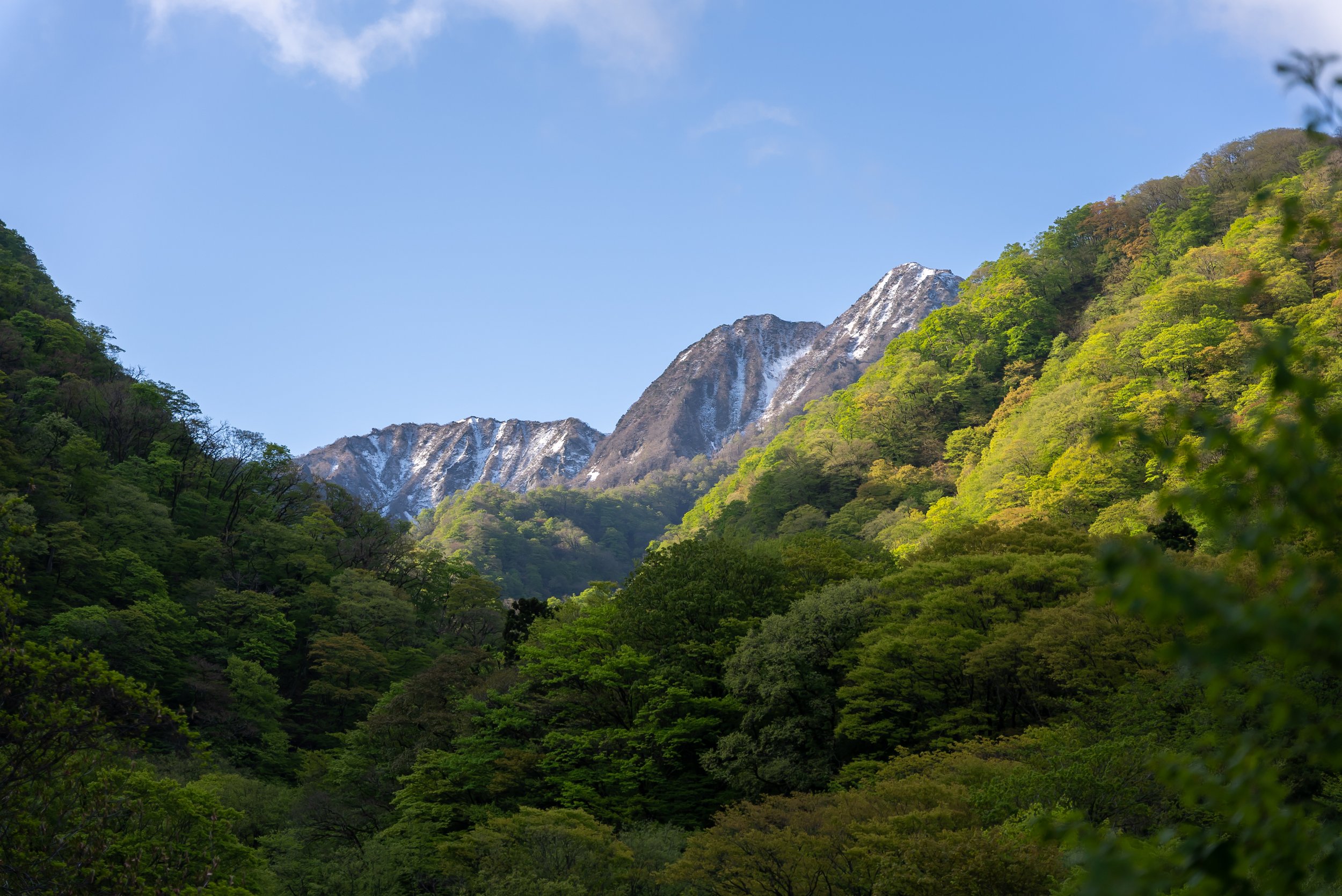
The Nawa River Basin on the northern side of Mount Daisen is a remarkable exception.
Here, Japanese giant salamanders breed and survive at very low elevations, extending almost to sea level.
Snowmelt and spring-fed streams originating on Mount Daisen help maintain cool, oxygen-rich water even during summer.
But this population also occupies a landscape that has been heavily modified by people.
The distance between mountain and sea is short, meaning agriculture, roads, settlements, concrete river engineering and other infrastructure are concentrated within a relatively small river system.
That makes Daisen's population particularly interesting — and potentially particularly vulnerable.
Life in the river
Japanese giant salamanders are predominantly nocturnal ambush predators.
Rather than relying heavily on vision, they locate prey primarily through movement in the water and chemical cues.
An individual will often position itself in moderate current and wait.
When prey approaches, the salamander opens its enormous mouth with remarkable speed, creating suction that draws the animal directly inside.
Small prey can be swallowed immediately.
Larger prey may be seized with the teeth — sometimes by the tail — and held for several minutes before being swallowed completely.
During periods of heavier river flow, salamanders may partially withdraw from the strongest current, resting against the riverbank while keeping their head and front of the body submerged and ready to strike.
What do Japanese giant salamanders eat?
Japanese giant salamanders are opportunistic predators.
Freshwater fish form an important part of their diet, together with freshwater crabs and, in some rivers, shrimp.
They also prey upon frogs, while aquatic insects — particularly caddisfly, mayfly and stonefly larvae — are frequently eaten by juveniles and smaller adults.
Small mammals, snakes and other vertebrates may occasionally be taken when they enter or are swept into the water.
Larger individuals will sometimes eat smaller salamanders, and cannibalism has been documented.
Japanese giant salamanders are also extraordinarily sensitive to chemical traces of animal tissue. Records following floods show them feeding opportunistically on fish and amphibian carcasses and even investigating discarded food waste and other animal material.
This highly developed chemical perception allows them to locate organic material at extremely low concentrations, whether the animal is alive or dead.
Breeding: the Den Master
Late summer transforms the normally quiet life of a Japanese giant salamander.
Males begin excavating and defending nesting chambers before females arrive. By around mid-August, males typically occupy suitable nesting burrows, with spawning generally taking place from late August to mid-September.
Competition for the best nesting sites can be intense.
Males may fight violently for control of preferred burrows, and scars, missing digits and even severely injured limbs can result. Fatalities, however, appear to be uncommon.
The strongest males gain control of the best nesting chambers.
These dominant males are known as den masters.
300–700 eggs
A female enters a nesting chamber and deposits approximately 300–700 eggs in long, bead-like strings.
Several females may contribute eggs to the same den during a breeding season.
There is no maternal care.
Instead, the den master remains in the chamber and provides all parental care.
He vigorously repels intruders and continually tends the developing eggs.
He fans the clutch with his tail for weeks, maintaining oxygen levels and helping reduce fungal growth. He may also consume dead, unfertilised or fungus-infected eggs, potentially helping prevent infection from spreading through the clutch.
It is an extraordinary investment in the next generation.
Sneaker males?
There may be another intriguing element to giant salamander reproduction.
When a female enters a nest to lay her eggs, the den master's aggression may temporarily decrease. During this period, smaller subordinate males may attempt to enter the chamber and fertilise part of the clutch.
This would be comparable to the "sneaker" reproductive strategies known from several other amphibians.
However, this behaviour has not yet been directly demonstrated in Japanese giant salamanders, so it remains a fascinating possibility rather than an established part of their reproductive behaviour.
From egg to giant
The eggs hatch after approximately 40–50 days.
Newly hatched larvae are only around 30 mm long.
Rather than immediately dispersing, they remain inside the den under the protection of the male for several more months. The den master may continue guarding the nesting chamber until late winter.
In the Nawa River Basin, our observations indicate that larvae reach approximately 40–45 mm by early to mid-February.
After leaving the nest, they typically conceal themselves among leaf litter and detritus in quieter, low-velocity areas along the riverbed.
Young Japanese giant salamanders possess conspicuous external gills.
Remarkably, these remain for approximately four to five years.
The gills begin gradually reducing at around 150 mm total length and are completely absorbed by metamorphosis at approximately 200 mm.
The exact age at which wild Japanese giant salamanders first reproduce remains unknown. Estimates based on body size suggest sexual maturity at approximately 267–322 mm in males and 390–445 mm in females.
Their slow development and extraordinary longevity have major implications for conservation.
A river can still contain many large adults even when very few young animals are successfully entering the population.
Finding adult salamanders does not necessarily mean that a population is healthy.
An ancient species facing modern threats
Japanese giant salamanders are remarkably hardy animals.
Large, old individuals can sometimes persist in slow, warm or polluted rivers — not because these conditions are suitable, but because fragmentation has left them confined there.
Their larvae and juveniles are far less able to tolerate poor-quality habitat.
This creates a dangerous conservation illusion.
A river may still contain large adult salamanders while successful reproduction and recruitment have already been severely reduced.
Across Japan, habitat fragmentation, pollution and hybridisation have reduced connectivity, genetic diversity and ecological integrity. In many watersheds, populations appear increasingly dominated by large adults — a warning sign of demographic ageing and long-term decline.
A fragmented river
Japanese rivers have been extensively altered by dams, weirs, concrete channels and other infrastructure.
The scale of this fragmentation in Daisen is extraordinary.
There are 53 artificial weirs in the Nawa River alone.
Each changes the river to some degree. Some present relatively minor obstacles, while others can prevent Japanese giant salamanders from moving upstream.
An animal may pass downstream during high water but then be unable to negotiate the same structure in the opposite direction.
Repeated dozens of times along a single river, these barriers transform what was once a connected ecosystem into a series of fragmented sections.
For a long-lived animal dependent upon access to feeding, shelter and breeding habitat, that matters enormously.
What our research in Daisen is showing us
Sustainable Daisen works with researchers to monitor Japanese giant salamanders in the Nawa River Basin and investigate how river modification, water quality, flow and habitat connectivity affect the population.
One of our principal study areas contains 11 consecutive weirs in the main Nawa River.
Immediately below this study section, a feeder river joins the Nawa.
The difference in habitat is striking.
The feeder river has cleaner water and considerably less concrete modification. As you move upstream, it becomes progressively more natural.
That is important when interpreting the distribution of salamanders.
The number of animals found below our 11-weir study section cannot simply be explained as salamanders being washed downstream and accumulating beneath the barriers. At almost exactly the same point, they also gain access to a tributary providing better-quality habitat.
Our research therefore considers habitat quality and connectivity together.
Barriers matter, but so do water quality, river engineering, flow, tributary habitat and access to suitable breeding areas.
We are also seeing potentially important differences between parts of the river system.
In the main Nawa, we have found predominantly larger animals and an apparent absence of the small juveniles that should be present in a successfully recruiting population.
Smaller salamanders have been observed in better-quality habitat elsewhere within the system.
We have also recorded physical wear and damage in animals inhabiting heavily modified sections of the main Nawa that we have not observed in salamanders from less disturbed habitat.
This leads to one of the most important questions in our research:
Are enough young salamanders surviving to replace the adults?
Counting adult salamanders alone cannot answer that question.
A river can contain numerous large, long-lived adults while the population is already ageing towards decline.
Reconnecting the river: Project B.I.G.
With 53 weirs in the Nawa River alone, habitat fragmentation is one of the major challenges facing Japanese giant salamanders here.
Sustainable Daisen created Project B.I.G. — Bypass Ramp Installation Gift — after approaching the authorities about installing bypass ramps and being told that, although the problem and potential solution were understood, there was not enough public interest to provide funding.
Project B.I.G. turns that problem on its head. We want to demonstrate that there is public interest in protecting the Japanese giant salamander — not only in Japan, but around the world. Individuals, businesses and organisations can fund a bypass ramp, which is then gifted for installation on the river.
In 2026, working with Japanese giant salamander specialists, we installed temporary wooden bypass ramps and began monitoring their use.
The ultimate goal is permanent bypass ramps on the Nawa River, allowing Japanese giant salamanders to move upstream past barriers and reconnecting sections of habitat that have been fragmented for decades.
Water quality matters
Connectivity is only part of the problem.
Japanese giant salamanders depend upon cool, well-oxygenated water, while their eggs, larvae and juveniles are particularly vulnerable to poor environmental conditions.
Runoff from livestock and poultry farms can introduce ammonia, phosphate, heavy metals and residues from veterinary medicines and feed additives. Agricultural chemicals applied to surrounding land can also enter waterways.
These pollutants can reduce oxygen, alter microbial communities and accumulate in sediment.
Concrete river engineering and dams can further change natural flow and habitat structure.
The result is not simply poorer habitat for salamanders. These changes affect the entire freshwater ecosystem — and the same water is ultimately used by local communities and agriculture.
Sustainable Daisen is therefore investigating water quality alongside salamander distribution, recruitment and habitat condition.
Our goal is not simply to preserve individual giant salamanders.
It is to restore the river ecosystem that allows them to survive and reproduce naturally.
The hybridisation crisis
Hybridisation with introduced giant salamanders from China is now one of the most serious threats to the genetic integrity of the Japanese giant salamander.
Wild hybrids have been documented in several prefectures, including Kyoto, Mie, Nara, Okayama, Hiroshima and Gifu.
In some areas, hybrids now represent the majority of recorded animals.
Genetic analysis of a surveyed section of Kyoto's Kamo River found that more than 98% of giant salamanders within the sampled area were hybrids.
In such rivers, genetically pure Andrias japonicus may already be functionally extinct.
Hybrid giant salamanders have been reported to exhibit vigorous and aggressive behaviour, particularly during feeding and territorial encounters. Systematic studies of their reproductive behaviour are still lacking, but hybrid males frequently become den masters, potentially accelerating the spread of introduced genes through subsequent generations.
Hybridisation may also have wider ecological consequences. Increased predation pressure from hybrids could affect native aquatic species that did not evolve alongside them.
Can you recognise a hybrid by looking at it?
Not reliably.
Pure Japanese giant salamanders tend to have a shorter, more rounded snout, proportionally shorter tail and more deeply wrinkled skin than introduced Chinese giant salamanders.
Colour and pattern can also differ.
But appearance alone is not sufficient.
Even experienced field researchers cannot conclusively determine whether an animal is a hybrid from morphology.
Genetic testing is required for accurate identification.
This makes regions such as Tottori and Shimane, which still support genetically pure populations, critically important to the long-term conservation of the species.
Conservation
The Japanese giant salamander is classified as Vulnerable on the IUCN Red List and Vulnerable on the Japanese Ministry of the Environment Red List.
It is also listed under CITES Appendix I, designated as a Nationally Endangered Species, and protected as a Special Natural Monument.
Yet there is a fundamental weakness in the protection it receives.
Japan's current legislation focuses primarily on restricting the handling, capture and possession of individual salamanders rather than adequately safeguarding or restoring their habitat.
A salamander can therefore be legally protected while the river in which it lives is fragmented, channelised, polluted or otherwise degraded.
Hybridisation has further reduced the number of genetically pure populations, while habitat degradation from agriculture, infrastructure development and water pollution continues to place pressure on the species — particularly in lowland rivers where human activity is greatest.
Protecting the Japanese giant salamander therefore requires much more than protecting individual animals.
It requires protecting and restoring the river itself.
That is why Sustainable Daisen combines population monitoring with water-quality research, habitat restoration, river reconnection and practical community-based conservation.
The Japanese giant salamander is an extraordinary species.
But ultimately, protecting it means protecting something much bigger: the rivers flowing from Mount Daisen and the entire living system that depends upon them.
Learn more
The biological information on this page is adapted from the Japanese giant salamander species account in:
Pearce, R. & Matsukoji, T. (2026). Reptiles and Amphibians of Japan. Edition Chimaira.
For more information about our work in Daisen, explore Project B.I.G., our Japanese giant salamander research and monitoring, or find out how you can support Sustainable Daisen's conservation work.
Donate
Sustainable Daisen is a Non-Profit Organisation based in Daisen Town, Japan. For a detailed breakdown of our fund-raising goals, please visit our “Save the Japanese Giant Salamander Campaign” page